Monday, May 6, 2013

CORE = ABS...An Incomplete Equation


Core training: A now almost essential part of many individuals’ training schedule.  A strong and stable core can prevent injury not only to the spine but also prevent injury to the rest of the body through stabilization. 
Let’s take a look at the core and core training more closely and along the way dispel a few misconceptions that the media and the random person at the gym, spewing “helpful tips”, have created.


       1.   First off, your abdominals (abs) are NOT your core.  They are part of the core, a large network of muscles that help stabilize not only your spine and torso, but your entire body while in motion and while stable.  Focusing on isolation exercises like crunches will only strengthen part of your core.  Furthermore the muscles of the core do not act in isolation so doing only crunches or ab exercises for core strengthening would be an incomplete way to train your core.

    2.    Core training is NOT about balance boards/wobble boards.  Stability training is helpful for patients needing to reactivate stabilizing muscles after injuries, but for someone who has not had any injuries that prevent activation of stabilizing musculature this is an incorrect way to train.  Trying to stabilize on an unstable surface is not going to create greater stability.  You are essentially adding instability to instability. The muscles and body need to adapt and stabilize on a stable surface.

3.      Core activation has been popularized in the media for “greater” benefits.  However the core is not something that should be activated all the time, the goal would be rather to have a core that has very little activation throughout our daily movements. A core that is active all the time means that the body is very unstable. This may sound a bit counterintuitive, but if we think about it, it would not make sense for a person to be doing a simple action or exercise with large amounts of core muscle activation. This would be like your body struggling and shaking while walking, the less your core has to activate, the more stability there is to the body.

4.      Core training is NOT only about bodyweight exercises.  Once the body adapts to movements there is little to no adaptation.  Adding in functional movements with unconventional training like sandbags, kettle bell movements, and parachute sprints can ensure that the body is always adapting and continues to improve.  This is a principle called progressive overload.

5.      Core strength is NOT only about slow movements.  Life does not consist of slow movements all the time.  Life and sports are explosive and you must train the core to transfer forces efficiently, not only in slow movements. You must incorporate more dynamic movements to supplement your workout. Exercises such as medicine ball throws, and elastic band snap downs are a couple of examples.

6.      Core strength is NOT possible without attention to breathing!  Regulating your breathing patterns plays an important role in stabilizing the torso during any type of movement. “Bracing” is very important in weight training and power exercises such as the Olympic lifts. This is very important for all sports as they ALL require fast and powerful movements.

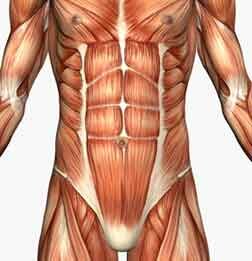
7.      Core strength is NOT only about the muscles you can see!  If you are just working on your “six pack abs” you will be missing many muscles that lie underneath (transverse abdominus, external and internal obliques)

8.      Core strength is NOT about doing high volume sets! "I do 300 crunches, 400 crunches, 1000 crunches a day, to maintain my six pack!" Realistically, if you want a "six pack", you need to be more focused on overall nutrition. And if you want core strength, you need to build up the core musculature comprehensively, i.e., both the anterior (front) chain and the posterior (rear) chain with compound exercises. Let me ask you a question. If you can do 300, 400 or 1000 crunches, how hard can they be? You should focus on good quality exercises executed with proper form and focus on tension throughout the movement. This means a core-specific movement or compound movements should be incorporated with control (proper bracing) through the entire range of motion. Explosive core movements, such as medicine ball throws, can be added once an individual has shown proficiency with the basic movement patterns.

9.      Core strength is NOT developed by always wearing a weight belt.  In fact you will be doing yourself more harm than good by always wearing a weight belt.  Belts are a great tool. A great tool to make you weak! Belts should only be used when needed, as in 1 rep max, not all of the time. If you are loading above 85%+ of the lifter or athlete’s one rep max (referred to as 1RM), a belt can then be used. Note: The 1RM is the absolute or total amount the lifter can lift in the respective exercise.  

Our bodies naturally create intra-abdominal pressure to lift heavy objects and perform movements quickly and powerfully through the core muscles. The transversus abdominis (transverse abdominis) is the body's natural weightlifting belt that stabilizes the spine and pelvis as you lift objects.  This muscle strengthens as you lift without a belt. If you use a belt you are training your body to not produce this intra-abdominal pressure on its own, leading to injuries when there is no weight belt present to provide that pressure. This can lead to hernias, and lower back injuries that can be pretty serious.

10  Core strength is NOT about "six pack abs"

Strongman competitors are some of the strongest people in the world and all have varying degrees of leanness in the abdominal area, in a sport where a strong core is THE most essential component to a competitor.

As stated, just because you’re ripped or shredded doesn’t mean anything when it comes to core strength. A ripped core only speaks to your current level of percentage of body fat. Having a strong core means that you are able to demonstrate stability across the torso during body movement.  More specifically, you can maintain proper positioning and bracing when your extremities (arms and legs) are in motion for any kind of activity.

 CONCLUSION

The human core is in pretty much everything that is not an extremity. Having a strong core will ensure that you can reach your goals, whether they be strength, speed, power, definition, size, endurance etc. Strengthen the core and you will reach new limits in your training. 

The following is a list of the muscles that make up the core of the human body.

·         Rectus Abdominis - located along the front of the abdomen, this is the most well-known abdominal muscle and is often referred to as the "six-pack" due to it's appearance in fit and thin individuals.
·         Erector Spinae- This group of three muscles runs along your neck to your lower back.
·         Multifidus - located under the erector spinae along the vertebral column, these muscles extend and rotate the spine.
·         External Obliques - located on the side and front of the abdomen.
·         Internal Obliques - located under the external obliques, running in the opposite direction.
·         Transverse Abdominis (TVA) - located under the obliques, it is the deepest of the abdominal muscles (muscles of your waist) and wraps around your spine for protection and stability.
·         Hip Flexors - located in front of the pelvis and upper thigh. The muscles that make up the hip flexors include: psoas majorilliacusrectus femorispectineussartorius
·         Gluteus medius and minimus - located at the side of the hip
·         Gluteus maximushamstring grouppiriformis - located in the back of the hip and upper thigh leg.
·         Hip adductors - located at medial thigh.


Turo Gamez NSCA-CPT


Category. (n.d.). The Best Core Exercises and Core Workouts. Sports Medicine, Sports Performance, Sports Injury - Information About Sports Injuries and Workouts for Athletes. Retrieved May 3, 2013, from http://sportsmedicine.about.com/od/abdomina

Willardson, J. M. (2007). Core Stability Training: Applications to Sport Conditioning Programs. Journal of Strength and Conditioning Research,21(3), 979-985.

Tuesday, March 26, 2013


Size matters... portion size that is!

Most of us are guilty of overindulging in our favorite decadent foods or eating until we feel that the buttons of our pants are about to pop right off. With many super-sized restaurant portions and enormous servings, it’s almost inevitable that we fall into this trap. However, with the proper guidance, game plan, and strategy, we can conquer this super-sized way of life. First off, it is important to understand why it is that we overeat. First and foremost, we eat for nutrition, energy, and to satisfy our hunger. It is when we have fulfilled those needs and keep going instead of knowing when to stop, that we go overboard. It is helpful to understand what kind of eater you are. Do you eat out of boredom, because the food is right in front of you, you don’t want it to go to waste, mindlessly eat, or maybe you are an emotional eater? Identifying which type you are, will definitely help you find the best strategy to kick this habit. Whatever your reason may be, learning the appropriate portion size for your body type is crucial for a healthy lifestyle and proper weight management. 
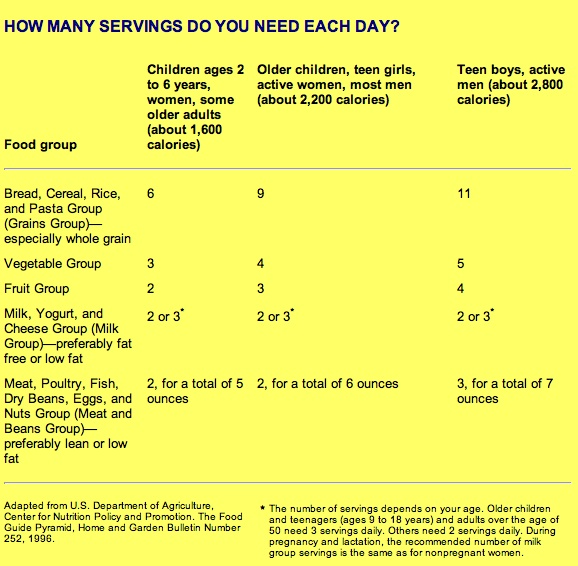
Daily recommended food intake:


True, the Food Pyramid is a bit old school but it still remains a great resource and handy reference. For a more personalized plan and updated guide, visit http://www.choosemyplate.gov/

A helpful guide for food measurements:


Helpful tips and strategies:

  • Eat out of plates, bowls, and cups that match your desired serving size. For example, you can purchase bowls that hold only 1 cup or other containers that have notches indicating various measurements. Eating right out of those measuring tools does the trick.
  • Prepare your food ahead of time. Dividing bulk foods into small ziplock bags according to serving size not only helps control how much you consume, but it is also extremely convenient especially when you are on the go. This also eliminates mindless eating straight from a family sized bag of chips, cookies, etc.
  • Divide your plate into food groups to make sure you are getting in all your servings of fruits, veggies, protein, carbs, etc. for the day.

  • Use smaller plates, bowls, and cups. Using an enormous sized bowl for cereal makes you want to fill the entire thing and you unknowingly end up eating double to triple the amount of an average serving size.
  • Use measuring cups- they work!
  • Keep a food log to keep yourself accountable. Think, do I really want to have to write down that I ate that spoonful of ice cream?
  • Read food labels for accurate serving sizes.


You do not have to eliminate certain foods completely from your diet, but keeping them in moderation as well as everything else is key. As children we have been told that we must “clean our plate” and make sure we eat everything. This is not the case; realize when you are full and when to stop. It is more than okay to bring home leftovers. Remember, everyone is different; find the strategy that works best for you and you’ll be well on your way to a healthier you. Finally, the combination of a well-balanced diet along with regular physical activity is the key to an overall healthy lifestyle.

References

"ChooseMyPlate.gov." ChooseMyPlate.gov. N.p., n.d. Web. 26 Mar. 2013.
"Dietary Guidelines: Build a Healthy Base." Dietary Guidelines: Build a Healthy Base. N.p., n.d. Web. 26 Mar. 2013.
"Your Guide To Calories And Portion Sizes." Prevention. N.p., n.d. Web. 26 Mar. 2013.

Kimi Ma
ACE-CPT

Thursday, March 14, 2013

Having a Partner vs. Working out Solo


You may be trying hard to get regular exercise and make healthy food choices, but if you don't have like-minded friends, this can be hard to get into. Working out by yourself can be pretty difficult. I highly recommend finding a workout partner to maximize your program. When it comes to exercise, you don't have to go it alone. In fact, studies show you'll improve your overall results by working out with a partner. It's why Lance Armstrong and Matthew McConaughey team up for athletic challenges, and why Madonna and Gwyneth are forever together at the gym. Even Barack and Michelle are known for sweating it out together. Yet, sometimes it’s not for everyone. There are some benefits to working out by yourself as well as with a partner.

There are 5 key reasons why having a partner is a good course of action:

1.    They provide motivation. Having a partner helps for the days when you don't want to work out, they will be there to get you out the door. And for the days they feel like skipping, you will get them to the gym. When you want to give up completely, they will talk you into sticking with your plan.

2.    They serve as spotters. When you do exercises such as bench press, squats, military press, etc. Your partner can help spot you. They will keep your workouts safer yet more challenging at the same time, along with checking your form to make sure it is proper the whole time. By having a spotter you will be able to push yourself to new peaks because you will have them to help you.

3.    They increase your exercise arsenal. There are numerous strength moves you can do with your partner, like crunches with a medicine ball, partner pushups and leg tosses. These are fun and very effective.

4.    They provide companionship. Misery loves company. Working out can be lonely, especially long cardio sessions. Having a friend next to you to talk with while you slave away on the elliptical can make the time fly by and actually make it fun rather than a chore.

5.    They provide competition. There is nothing in this world that makes us as human beings push ourselves to new limits like the thrill of competition. If you have a partner who is slightly stronger than you, it can be surprising to see how hard they will push themselves to surpass their partner and they joy they would get from doing so.

Some reason to go solo:

1.    Nothing but time. When you work out by yourself there is nothing holding you back except you. You don't have to wait for anyone to work out just when it is convenient for yourself and you can make your workout as long or as short as you want it to be.

2.    Speed efficient. Generally working with a partner takes longer do to the waiting time in between set. If you just want a quick workout you are able to power through it without a partner holding you back. Especially if you and a partner are at different strengths, you lose a lot of time simply changing the weights.

3.    Less distractions. Working out by yourself also takes out distractions. It allows you to focus on your workout and tune the outside world out. Too often there are just workout groups standing around and talking rather than actually working out.

Moral of the story is plan to see that having a partner is in most cases seems to provide more benefits than working out by yourself. I personally work out on my own normally only for the reason that my schedule doesn't allow me to really link up with a partner. I would work out with a partner if I had the option. Working out by myself is annoying sometimes because I can't push myself to my max potential in certain areas without one. Plus it's nice to see gains as a team; it makes the sense of accomplishment greater. So if having a workout partner is not for you, that’s fine, but at least consider giving it a try.


-Will Perdue
AFFA Certified
U.S. Marine

Thursday, February 28, 2013

Don’t Skip Carbs


We all need energy in order to exercise and work out. Whether your goal is to lose weight, gain muscle, or train for a sport, everyone needs a certain amount of energy (Earle & Baechle, 2004). Carbohydrates represent the main energy source for our body. In addition, carbohydrates are necessary for complete metabolism of fatty acids, which helps prevent ketosis (a potential harmful condition). So when you see people cutting out carbs completely from their diet, they are not only depriving their body of energy to exercise (hence they are cranky), but they are also putting their body at risk for ketosis.

The body stores carbohydrates in the form of glycogen within the liver and muscles. The muscle glycogen storage represents the largest reserve, followed by liver storage, and a small percentage in the blood (McArdle, Katch & Katch, 2010).

Role of Carbs

  1.  Energy source: Main energy source for exercise
  2.  Protein sparer: Helps preserve our body’s protein tissue by not breaking it down for energy; a lack of glycogen stores causes the body to derive glucose from our amino acids (protein), which is not what we want
  3. Prevents ketosis: parts of carbohydrate breakdown assist in fat oxidation, which ultimately helps prevent accumulation of ketone bodies (ketosis)
  4. CNS fuel: our central nervous system needs a continuous stream of carbohydrate energy for proper functioning; it solely relies on carbohydrates for energy; a lack of this energy to the CNS can impair exercise performance and if sustained, can ultimately lead to unconsciousness and brain damage


How much?

The recommended intake for physically active individuals, according to exercise physiologists, should be around 60% of daily calories. For high intensity training, it is recommended to increase that percentage to about 70% of total calories (McArdle, Katch & Katch, 2010).

Scientific evidence has proven that a carbohydrate deficient diet depletes muscle and liver glycogen at a rapid pace. In addition, it impairs performance in short anaerobic exercise and prolonged intense aerobic exercise (McArdle, Katch & Katch, 2010).

What to eat?

-          Whole Grains (pasta, cereal, bread)
-          Vegetables (broccoli, asparagus, etc)
-          Fruits (oranges, berries, pears, etc)


Moral of this blog: Eat your carbs!

Ryan Benito
NSCA-CPT


References

McArdle, W. D., Katch , F. I., & Katch, V. L. (2010).Exercise physiology. (7th ed.). Baltimore, MD: Lippincott Williams & Wilkings.

Earle, R. W., & Baechle, T. R. (2004). Nsca's essentials of personal training. Champaign, IL: Human Kinetics.

Wednesday, February 27, 2013


THE MIGHTY EGG and CHD
 Myths and Facts
The egg, one of nature’s near perfect foods, has received negative attention in recent years and reductions in egg consumption have been widely recommended to lower blood cholesterol levels and prevent coronary artery disease (CHD). Taking a closer look however, many of the studies that were conducted did not find a  correlation with the cholesterol found in eggs to CHD. 
In these studies many factors were not taken into account, such as the levels of fats and saturated fats that the participants consumed on a daily basis. Let’s remember that all of these things; fats, saturated and unsaturated (along with salts and sugars), cholesterol including low density lipoprotein (bad cholesterol) and high density lipoprotein (good cholesterol) are all essential for our bodies.  They are all used to maintain the daily functions our bodies perform. The problems come from elevated levels of many of these in an individual’s daily diet.
The egg yolk though feared, actually contains an abundance of vitamins including the 4 essential fat soluble vitamins that help your body function, healthy fatty acids, all the essential amino acids required and various minerals.  Tossing out the egg yolk, means you lose 100% of the fat soluble vitamins contained in eggs. A,D,E,K and carotenoids. You may ask yourself what the fat soluble vitamins actually do, and the truth is they do much more than you can imagine. Fat soluble vitamins boost your immune system, reduce risk of cancer, keep your bones, teeth and skin healthy, support the thyroid gland, reduce the damaging effects of diabetes, and promote healthy growth in children to list but a few.
 
 Conclusion
To avoid elevations in blood cholesterol and reduce CHD risk the public has been advised to consume no more than 300mg per day of cholesterol and limit consumption of eggs, which contain about 213mg of cholesterol per egg.  However eggs contain many nutrients besides cholesterol, including unsaturated fats, essential amino acids, folate and other B vitamins. In addition, consumption of eggs instead of carbohydrate-rich foods may raise high-density lipoprotein (HDL) cholesterol levels and decrease blood glycemic and insulinemic responses.
So unless you have a prior heart condition, there’s no need to dispose of the yolk, and as long as your diet is relatively clean and you stay away from processed and fast foods you have little to fear from the egg.

 Turo Gamez NSCA-CPT

were, b. f. JAMA Network | JAMA | A Prospective Study of Egg Consumptionand Risk of Cardiovascular Diseasein Men and Women. JAMA Network | JAMA | Home. Retrieved February 4, 2013, from http://jama.jamanetwork.com/article.aspx?articleid=189529
Baechle, T. R., & Earle, R. W. (2000). Nutrition Factors in Health and Performance. Essentials of strength training and conditioning (2nd ed., pp. (.,)). Champaign, Ill.: Human Kinetics. 
 

Sunday, February 24, 2013

Protein Intake: Past and Current Research

We have all seen the ads on TV and in magazines for protein powders, protein bars and other high protein drinks, advertised as essentials that everyone should add to their diet in order to have ripped abs and big muscles, but is that extra protein actually helping us out? Are our bodies utilizing all the protein we take in?

In a study performed in 2008 by Moore et al., it was found that muscle and albumin protein synthesis were maximally stimulated at a dose of 20 grams of protein following resistance exercise. Increasing doses of protein following resistance training were shown to have no further increase in mps or aps, and protein in excess of this amount was found to be lost to oxidation. In another study performed in 2009, focusing on young and elderly subjects, by Symons et al., a comparison of 30 grams of protein consumption and 90 grams was observed. In this study it was shown that the muscle protein synthesis was increased by 50% with a 30 gram does of protein and that no further increase in muscle protein synthesis was observed at higher doses. Based on the results from these two studies it has widely been accepted that no further benefit would be seen in a practical setting in which individuals were ingesting more than 20 to 30 grams of protein per meal. However, more recent studies have contradicted this widely held dogma.

While muscle protein synthesis does appear to reach its upper limits approaching 20-30 grams of protein, studies have shown that protein intake serves a larger role inside the body than just to build muscles. In a review written by Drs. Deutz and Wolfe, the two examine why this long held belief that individuals utilizing the 20-30 gram intake range per meal might be misguided. In their article, Wolfe and Deutz discuss the overall affect of protein ingestion as it relates to anabolism (the synthesis of complex molecules from simpler ones). In their article they explain that the anabolic response is measured as a function of both protein synthesis and breakdown and that projections of anabolism compared to protein intake have no maximal limit incontrast with the long held belief of ingesting at most 30 grams of protein per meal.

While these seperate indications for protein intake may be contradictory we can take away a few things from these observations. While earlier research performed by Moore et al. and Symons et al. show a maximal muscle protein synthesis at 20-30 grams of protein intake a meal, Wolfe and Deutsz suggest that this figure may not take into account a realistic view of metabolism of an individual in their daily life.

Remember that protein is not used just for muscle synthesis. It also plays vital roles in several other functions of your body. Consumption of protein has also been found to increase satiety. As with all diet changes, be sure to consult with a healthcare professional, especially if you have any pre-existing health conditions.

To Your Health,
Ryan Hasapes 

References
1.Deutz NE, Wolfe RR. Is there a maximal anabolic response to protein intake with a meal?. Clinical Nutrition. 2012 November 27

2.Symons TB, Sheffield-Moore M, Wolfe RR, Paddon-Jones D. A moderate serving of high-quality protein maximally stimulates skeletal muscle protein synthesis in young and elderly subjects. J Am Diet Assoc. 2009 Sep;109(9):1582-6.

3.Moore DR, Robinson MJ, Fry JL, Tang JE, Glover EI, Wilkinson SB, Prior T, Tarnopolsky MA, Phillips SM. Ingested protein dose response of muscle and albumin protein synthesis after resistance exercise in young men. Am J Clin Nutr. 2009 Jan;89(1):161-8.